
.JPG)
Education that moves with your child, built on lived skills, real-world Quests, and a community that travels with you.
Worldschooling lets your family live, travel, and learn together instead of pausing education to see the world. The best worldschooling programs for families are now structured, accredited, and community-led: place-based learning, a clear skills framework, and cohorts where real friendships form. For years the question was whether you could give your children a serious education on the move. The better question, and the one this piece answers, is what that education looks like when it is built on purpose. Here is where it is heading, and how we are building it at Boundless.
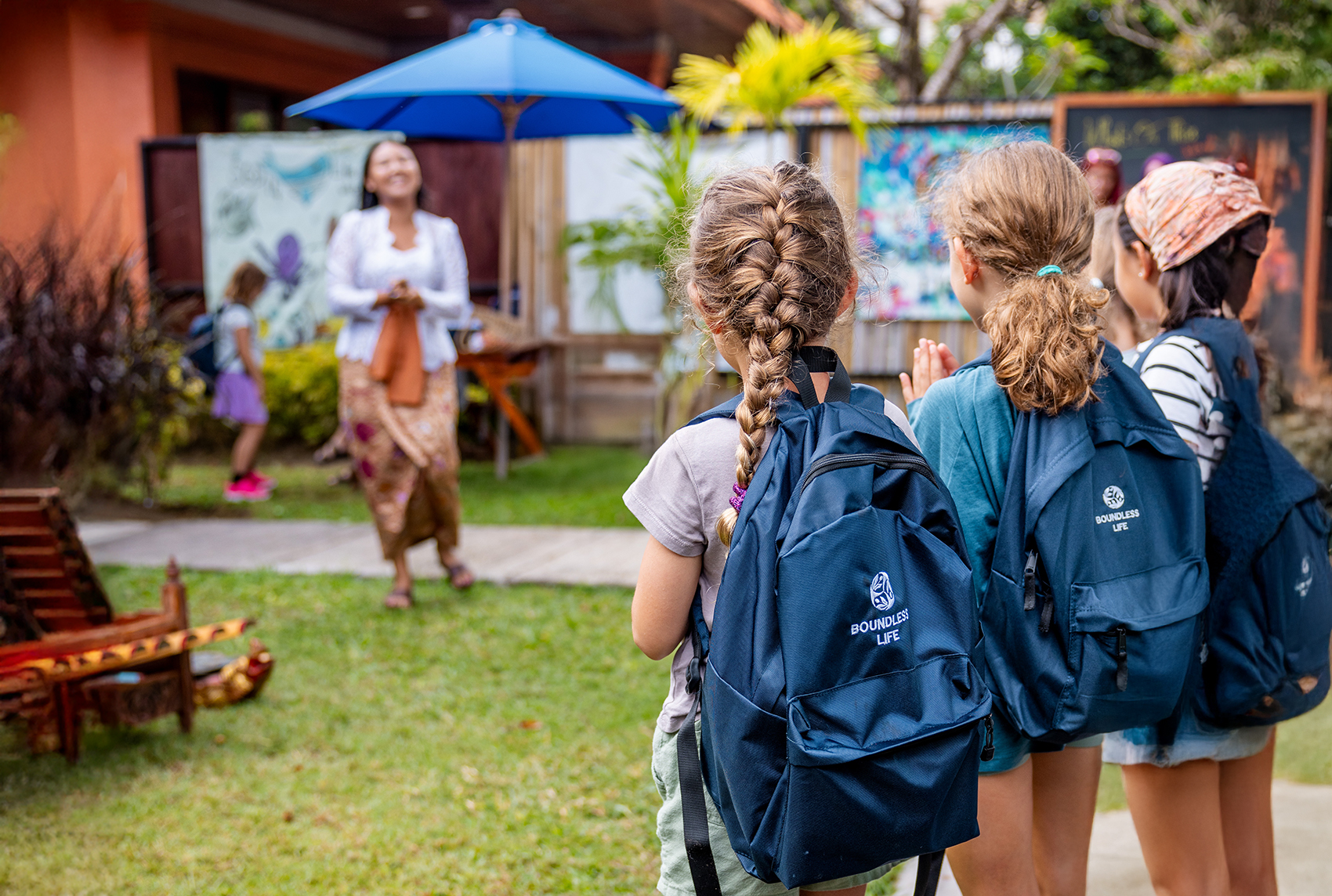
Worldschooling Programs for Families Have Gone Mainstream
Worldschooling is the practice of learning through travel, where the place your family lives becomes the classroom and the curriculum follows your child from one country to the next. It is no longer a fringe choice. Somewhere between 1.5 and 2 million families now worldschool in some form, and the rise of remote work has normalized a life where parents earn from anywhere while their kids learn everywhere.
What changed is not the appetite for adventure. Families have always wanted to show their children the world. What changed is that the logistics, the education, and the community finally caught up. You no longer have to choose between a passport full of stamps and an education you trust. The next generation of worldschooling programs for families is designed to deliver both at once.
An Education That Moves With Your Child
The old model treated school as a fixed place you leave and return to. The future treats learning as something portable, something that travels in the child rather than waiting at home. That single shift changes everything about how a program is built.
When we started Boundless, we tried to be everything for every family, and we learned quickly that this is not how you build something excellent. So we narrowed to five promises we can keep in every location: skills your children live rather than memorize, projects with real community impact, a peer group built on genuine connection, growth you can actually see and track, and an education that moves with your child.
That first promise is the heart of it. We design for "skills that are lived not taught," which means your child does not just read about a community challenge, they go into the community and work on it. Place is not a backdrop. It is the lesson.
Learning a Language by Living In It
The clearest example of place as lesson is language. Starting in September 2027, La Barra in Uruguay becomes the first Boundless destination to run a full Spanish and English dual-language program. This is not a language class bolted onto the school day. Educators move naturally between Spanish and English throughout the day, during projects, morning gatherings, and excursions, so your child picks up the language the way they learned their first one, by being immersed in it rather than studying it on the side. In Spain, the approach is different but just as intentional, with structured Spanish sessions woven into the program twice a week. Neither location requires any prior Spanish. The philosophy is the same in both: children learn by doing, not by drilling.
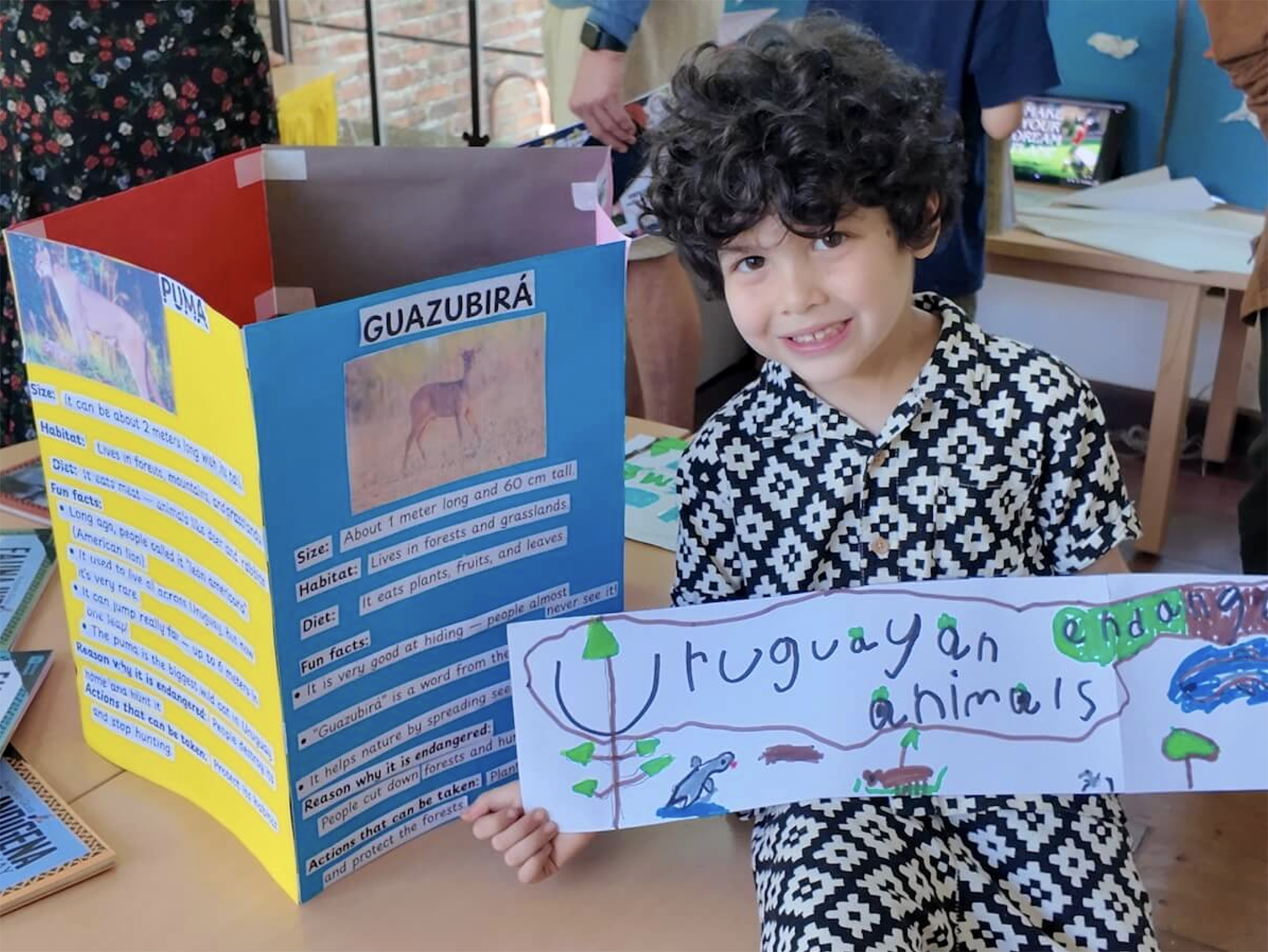
The Boundless 8 and Real-World Quests
A serious program needs a serious spine. Ours is the Boundless 8, a competency framework that runs through every project, workshop, and field trip, from the youngest Explorers to the oldest Trailblazers. Four competencies cover the academic foundation: thinking deeply, reasoning and solving, creating boldly, and communicating with impact. Four more cover the social and emotional core: knowing yourself, keeping growing, connecting across cultures, and navigating the world.
These last four are not soft skills. They are the skills that decide whether the academic ones ever matter in real life. A child who knows herself learns faster and recovers faster. A child who can collaborate across cultures is practicing it daily, not reading about it.
The framework comes to life through Quests. Each cohort works on a place-based project tied to a United Nations Sustainable Development Goal, with educators mentoring students through themes like sustainability, equality, justice, community, and well-being. Rather than teaching subjects in isolation, a Quest blends them, the way real problems actually arrive.
Every Quest follows the same four-phase arc, and seeing it play out makes the model concrete. Picture a cohort in a coastal town wrestling with the shared question of how their community protects its water and marine life.
- Shared inquiry. The whole cohort starts from one question or provocation, regardless of age or background, so every child has a way in.
- Explore and connect. Children head out into the place itself, visiting local organizations, interviewing residents, and walking the coastline to find their own angle on the question.
- Create and build. Each child makes something real. One might build a prototype filter, another might produce a short documentary, another might pull together a data report or a written argument.
- Share and reflect. They present the work to their peers and the wider community, then sit with what they actually learned and what they would do differently.
Because each child chooses their own path through the inquiry, the Boundless 8 competencies show up differently for every learner, and every Quest becomes a portfolio piece that connects classroom learning to the world outside the window.
How a Worldschooling Program Works, Day to Day
The most common question from parents is a practical one: what does a day actually look like? Here is the shape of a day inside a Boundless Education Centre.
- Connection Time. The day opens with a mindful moment and discussion built around character, so your child centers before learning begins.
- Mastery Time. Core academics come next, using an individualized approach so your child masters a concept before moving on.
- Quest Time. Children work in groups on their place-based, real-world project tied to a UN goal.
- Culture, Nature, and Boundless Time. Across the week, your child spends time in the local culture, in nature, and on passion projects that light them up.
- Endeavour Time. Parents and community members come in weekly to share their own expertise, which expands learning well beyond the educators.
Across a three-month cohort your child also takes part in a minimum of four field trips and a Boundless Junior Forum, a child-led assembly held twice a month where students shape their own learning environment and practice real decision-making. To go deeper on the model, see Boundless Education.
Where Kids Build Real Friendships
The fear that stops most parents is not academic. It is social. They worry their child will be lonely, always the new kid, never settled long enough to belong. It is the most important objection to answer honestly, so here is the honest answer: friendship is structural in a good worldschooling program, not accidental.
Cohorts travel together and stay in one place for three months, which is long enough for real bonds to form rather than fleeting holiday hellos. Children move between countries and cohorts often enough that connecting across cultures becomes a daily practice. One parent, Kristen Sarah, put it plainly after her family's stay: "Our daughter made best friends and learned a lot in the 3 months." Another family, the Broadways, described real growth in both their daughters, not only academically but socially and emotionally.
That is the difference between travel that interrupts friendships and a program designed to grow them.
.jpg)
Keeping University Doors Open
Rigor is the other thing parents need to trust before they commit. A future-ready program cannot trade academic credibility for adventure, so the structure underneath matters.
Our math program is built on White Rose Maths, a mastery-based curriculum aligned to international standards and similar in spirit to Singapore Math, complemented by Century Tech, an adaptive platform that personalizes practice to each child's pace. Literacy is focused and cyclical, building reading and writing skills that deepen over time. For older students, the Trailblazers program pairs in-person Boundless learning with structured online academics through Crimson Global Academy, a fully accredited online school with a strong record of placing students into top universities. Boundless covers the cost of that base academic provider.
Two further signals of seriousness: the Worldwide Association of Schools and Colleges has granted candidacy status to five of our locations, with a self-study process underway across all destinations, and starting September 2026 the Trailblazers program runs year-round in Tuscany, Japan, and Spain, so your family can register at any time and customize the timing and location to fit your plans. Explore the older-student path at Trailblazers.
Worldschooling, Homeschooling, and Traditional School Compared
If you are weighing your options, it helps to see them side by side. Each path has a real place. The right one depends on what your family wants most.
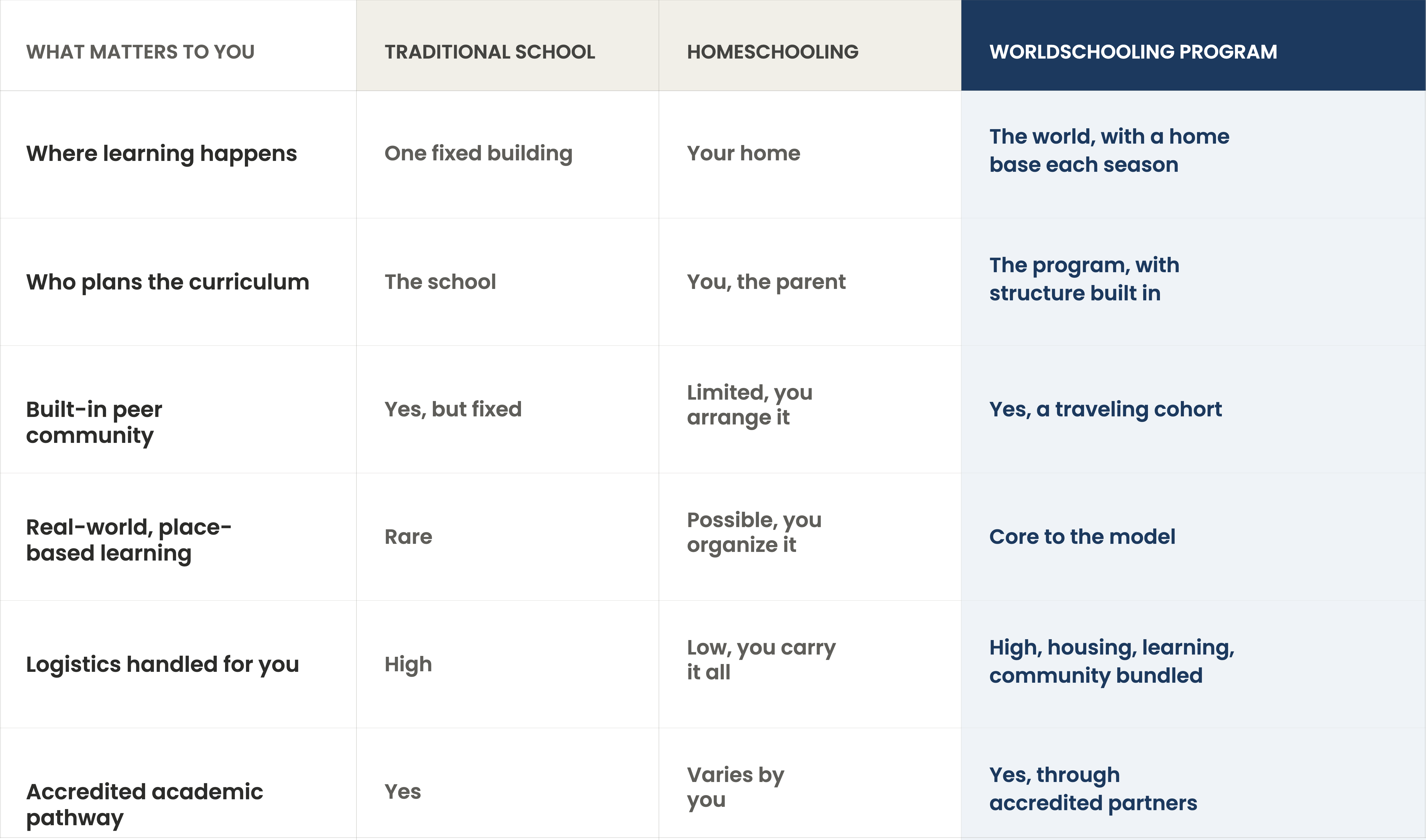
Homeschooling gives you total control and asks you to carry every logistic. Traditional school gives you structure and asks your family to stay put. A worldschooling program is built for the family that wants structure and the world at the same time.
The Best Age to Begin
Boundless Education is built for children aged 2 to 14, and the program meets your child at the stage they are in. The youngest learners, the Explorers, follow a Montessori-inspired approach rooted in hands-on discovery, independence, and a genuine love of learning. The primary-years Pathfinders take an active role in their own education, inspired by the Finnish model that encourages children to pave their own path. The middle-years Trailblazers follow a hybrid model that blends place-based learning with accredited online academics.
There is no single perfect age to start. The Explorers years build confidence and curiosity, the Pathfinders years build independence, and the Trailblazers years build self-direction ahead of high school. You can begin where your child is. See Explorers and Pathfinders for how each stage works.
Not a Vacation From Life
It would be easy to sell worldschooling as a long holiday. That is not what it is, and parents see through that anyway. A three-month Boundless program is not a break from real life. It is an invitation to live more fully inside it: slower mornings, deeper family time, and a child who is learning to see the world and themselves differently as the scenery changes around them.
We are honest that the model is not finished. We are still learning, still improving, and we believe the best of this work is ahead of us. That humility is part of the design. The future of worldschooling programs for families will be built by the families and educators living it, season after season, in real places, together.
Frequently Asked Questions
What is worldschooling? Worldschooling is learning through travel, where your family lives in different places and the local environment becomes part of the education. In a structured program, a consistent curriculum and community travel with your child, so learning continues no matter where you are in the world.
Do worldschooled kids make friends? Yes. In a cohort-based program, children travel and learn together and stay in one location for around three months, which is long enough for genuine friendships to form. Moving between cultures also makes connecting with new people a regular, practiced skill rather than a one-time challenge.
Is worldschooling worth it? For many families, yes. Parents consistently report children who grow academically, socially, and emotionally, alongside closer family bonds and real cultural fluency. The strongest worldschooling programs for families pair that experience with structured, accredited academics so the growth does not come at the cost of credibility.
What is the best age to start worldschooling? Boundless welcomes children aged 2 to 14, and any age within that range can be a strong starting point. Younger children build confidence and curiosity, primary-years children build independence, and older children build the self-direction they will carry into high school.
Is the Boundless curriculum accredited? Yes. Older students follow accredited online academics through Crimson Global Academy, a fully accredited partner with a strong university-placement record, and five Boundless locations currently hold candidacy status with the Worldwide Association of Schools and Colleges.
Start Your Family's Worldschooling Journey
The world is ready to be your child's classroom. If you want an education that moves with your family, builds skills your children live rather than memorize, and surrounds them with a community that travels alongside them, explore Boundless Education and discover the World School Year. Your next chapter is waiting out there.


.avif)

